Jason Houle, PLS, explains how a strategic approach to survey equipment acquisition and management can boost productivity and position your firm for growth.
Survey equipment is more than a capital investment; it’s the backbone for any company that offers professional land surveying services. Across the country, civil/survey firms, whether operating locally, regionally, or nationally, face a common set of challenges when it comes to managing their equipment.
As someone who has been a partner in a multidisciplinary firm and a strategic consultant to firms of all sizes, including large national organizations, I’ve experienced firsthand how difficult it can be to maintain consistency, control costs, and stay competitive while managing equipment.
The Realities of Equipment Planning
Regardless of whether your firm is growing or maintaining a steady footprint, the operational challenges remain:
- Partial annual upgrades leave some crews with outdated gear; this creates inefficiencies and morale issues.
- Mixed brands and/or vintages of a common brand across offices complicate workflows, support and training.
- Non-standard setups make it difficult to share resources or shift personnel between projects.
- Project-driven needs require flexible acquisition models, not just one-time purchases.
- Rapid tech evolution forces firms to choose between staying competitive or staying solvent.
- Downtime from repairs or maintenance bring scheduling challenges, decrease utilization rates and derail project timelines.
- Unpredictable costs make it hard to forecast and manage budgets.
These are not just growing pains; they are persistent issues that affect firms of every size and structure.
Financial Strategy in Equipment Acquisition: Not One-Size-Fits-All
For civil/survey firms, equipment acquisition is not just a technical decision; it is a financial one. Some firms prefer capital purchases, aligning with long-term asset strategies driven by cash flow and depreciation schedules. Others benefit from operational expense models, which offer predictable monthly costs and preserve capital for other investments.
Each approach has its advantages:
- Capital purchases may offer tax benefits and long-term ownership value
- Operational expense models can improve cash flow and simplify budgeting
- Hybrid strategies allow firms to match acquisition methods to project timelines and financial goals
Understanding these options can help you make an informed decision that supports your firm’s operational efficiency and financial health.
Annual Maintenance: Operational Due Diligence
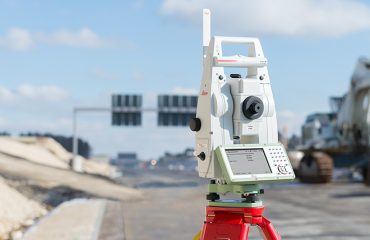
Survey equipment is exposed to the elements. It is transported from job to job in trucks, trailers, and even aircraft. It is used in heat, cold, dust, and rain, and it needs to perform with precision every time. Annual maintenance is not optional; it is essential due diligence. Keeping equipment within spec is not just about performance; it is often tied to project certification requirements. A missed calibration or delayed service can lead to rework, disputes, or worse.
A well-defined maintenance strategy will help your firm:
- Minimize downtime through scheduled service coordination
- Maintain productivity with loaner equipment during service windows
- Ensure compliance with certification standards and client expectations
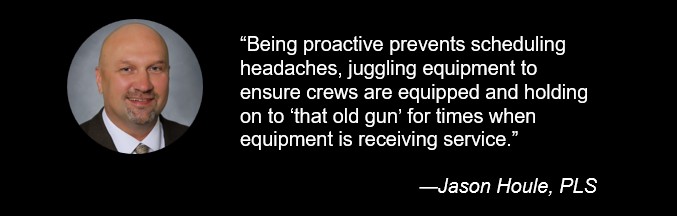
Being proactive prevents scheduling headaches, juggling equipment to ensure crews are equipped and holding on to “that old gun” for times when equipment is receiving service.

Standardization Across Crews: A Strategic Advantage
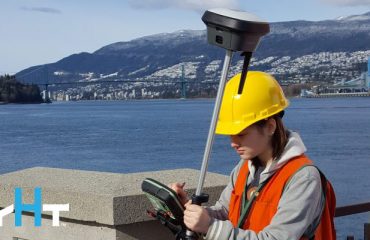
When crews across offices are equipped with the same hardware, including GNSS systems, total stations, controllers, field software, batteries, chargers, tribrachs, poles, and other essential accessories, efficiency improves.
- Data workflows are consistent.
- Training is streamlined.
- Support is simplified.
- Resources can be shared seamlessly, locally, regionally, and nationally.
Standardization allows firms to shift crews between projects, lend equipment across offices, and maintain a unified operational standard without compromising productivity or deliverable quality.
Scale with Confidence
We’ve all experienced unexpected projects that strain resources and drive demand growth. Understanding your organization’s strengths and weaknesses in equipment management is the first step in creating a clear plan.
When a major project is awarded or additional crews are added, you need to scale quickly and without disruption. A defined equipment acquisition strategy positions you for success in an environment that demands agility. Additionally, a well-designed acquisition model results in:
- Consistent deployment of new technology
- Optimized equipment utilization rates
- Timely project delivery
- Training and adoption paced to match operational needs
Aligning your equipment strategy with operational demands takes planning and diligence, but it can be achieved through flexible equipment acquisition options, standardized onboarding, and lifecycle support that keeps crews productive and projects on track.
If you want to make sure you’re positioned to scale successfully, let’s talk.
About the Author
 Jason Houle, PLS, is manager of the Survey KAM program at Leica Geosystems, part of Hexagon, where he leads strategic initiatives to drive growth and operational efficiency for key clients. With over 25 years of experience in the surveying and geomatics industry, Jason began his career at R.H. Batterman & Co., advancing from survey technician to crew chief, project manager, and ultimately firm partner during his 17-year tenure. His experience spans both public and private sectors, including leadership roles at AECOM and Rock County, Wisconsin. A licensed professional land surveyor, Jason combines deep technical expertise with a customer-focused approach to deliver measurable results across the infrastructure and engineering landscape. Follow Jason on LinkedIn >
Note: This article was also published on LinkedIn. See the original article here >